Can you use stock photos on merch? What the license allows
Yes: T-shirts, mugs, stickers and print-on-demand are covered up to 500,000 copies. Selling the photo itself isn't. The line, an example and a checklist.
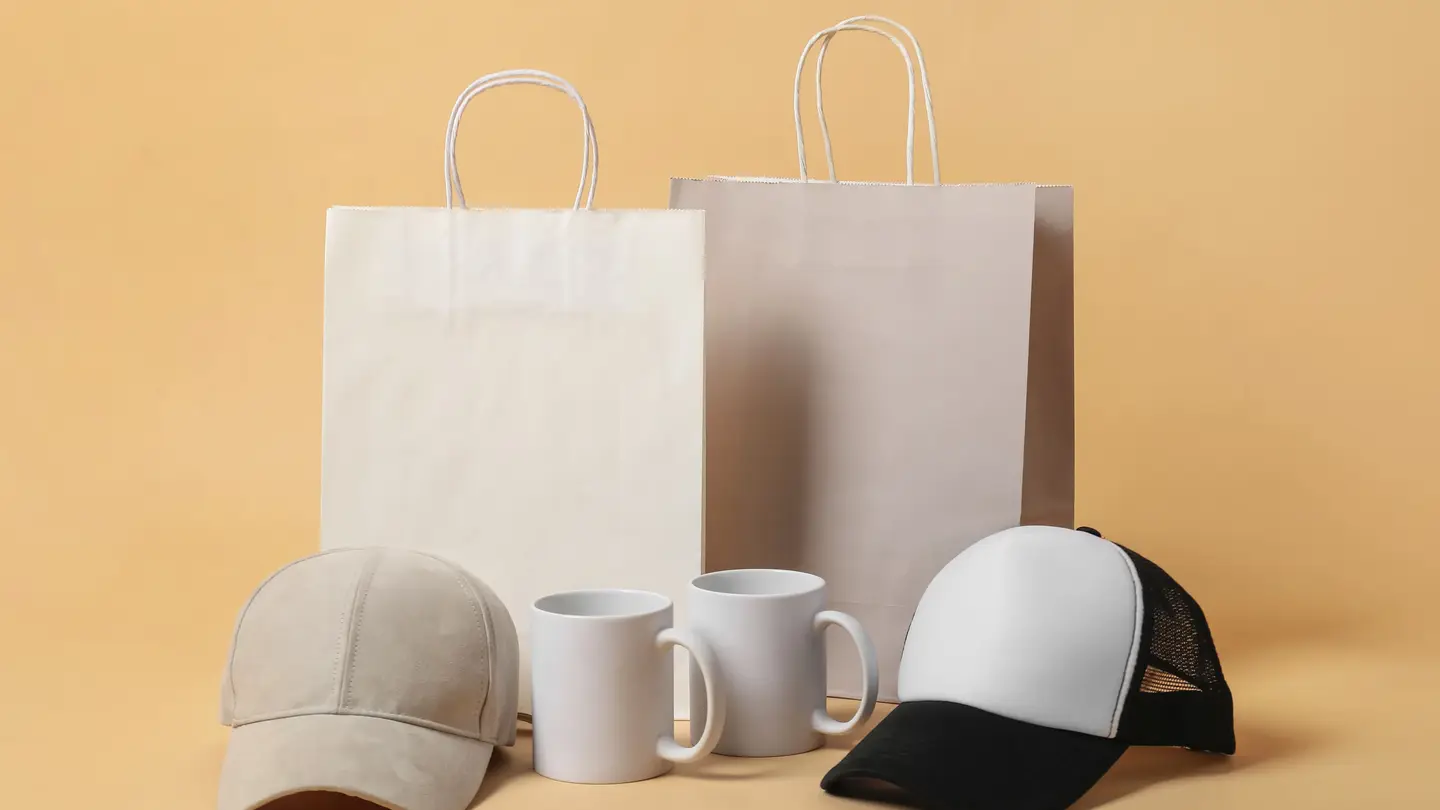
Yes, you can put a licensed stock photo on merch you sell: T-shirts, tote bags, mugs, stickers, packaging and print-on-demand products are all covered by our standard license, for print runs up to 500,000 copies. What you can’t do is sell the photo on its own, as a file, as if it were your stock to license.
This article shows where that line sits, walks through one real photo from our catalog and what you could make with it, covers the extra rules for photos with people or logos, and ends with a checklist to run before anything goes to print.
What counts as merch under the license?
Our license lets you use a stock photo “in commercial and personal projects,” and it names products alongside ads, websites and social posts. Merch is a product. So is anything else you make and sell with the photo as part of it.
In practice that covers:
- Apparel: T-shirts, hoodies, caps, socks, aprons.
- Home and gifts: mugs, cushions, blankets, tote bags, phone cases, calendars, greeting cards.
- Paper goods: stickers, notebooks, posters and art prints that carry your design.
- Packaging: labels, boxes, tissue paper, hang tags.
Each photo costs 10 credits ($0.10), and the license is worldwide with no expiry. The one number to keep in mind is the print run: up to 500,000 copies of a stock photo. Every printed item counts as a copy, whether you order a batch of 200 mugs or a print-on-demand service prints each order one at a time.
Where is the line between a product and reselling the photo?
The license rules out one thing in particular: you can’t “resell or redistribute the image on its own, as if it were your stock to license.” The question to ask is simple: is the buyer getting a product, or are they getting the photo?
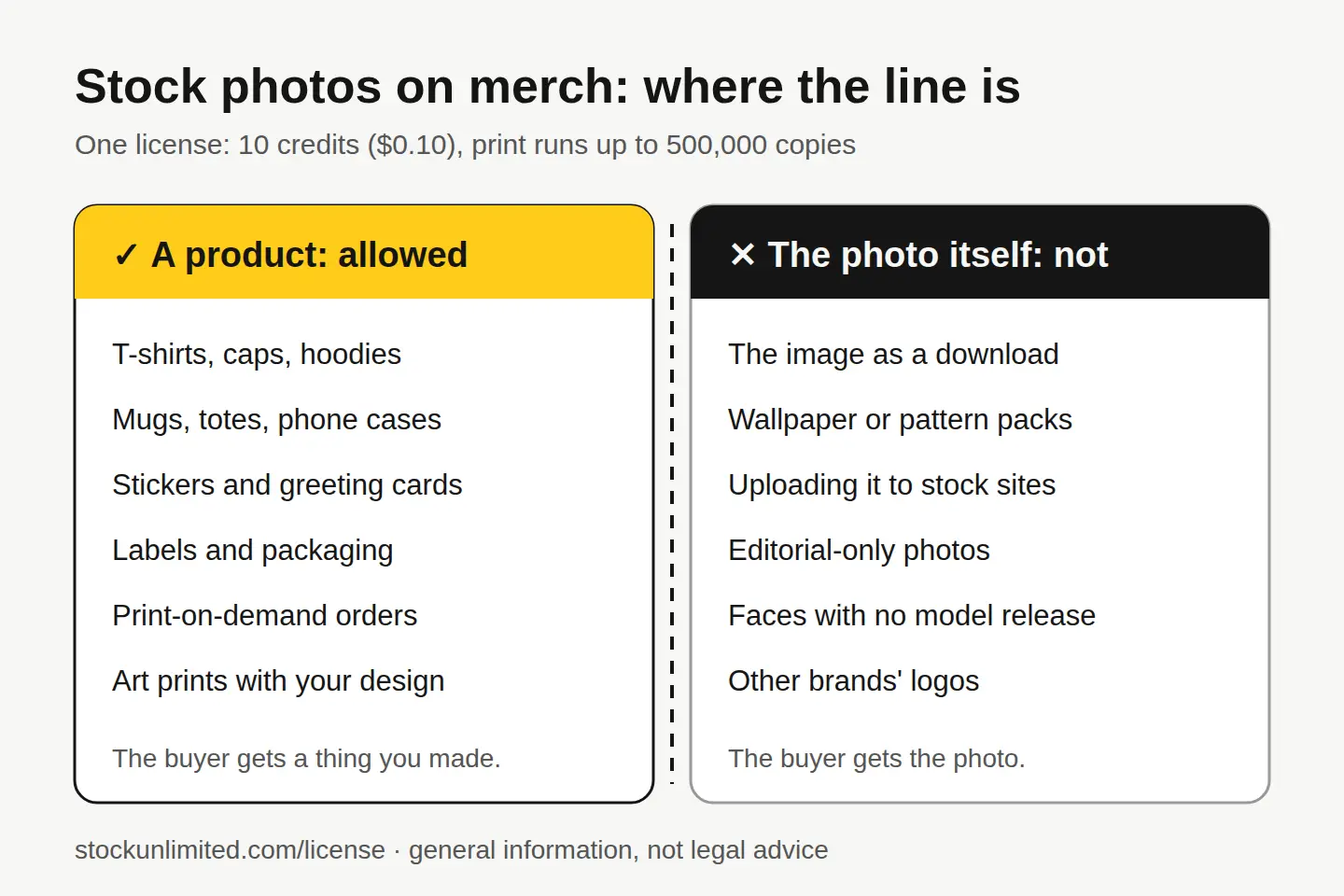
| Use | Allowed? | Why |
|---|---|---|
| A T-shirt with the photo in your design | Yes | The buyer gets a shirt |
| Print-on-demand mugs sold from your shop | Yes | Each mug is a product; each one counts toward 500,000 copies |
| Product labels and packaging | Yes | The photo is part of your product |
| The JPG sold as a “digital download” | No | The buyer gets the photo itself |
| A phone wallpaper or “pattern pack” of the photo | No | Still the photo, redistributed as a file |
| Uploading it to a stock or template site as yours | No | That’s licensing someone else’s photo |
| An editorial-only photo on a T-shirt | No | Editorial-only photos can’t be used on products |
One gray area is worth naming: an art print that is nothing but someone else’s photo, with nothing of yours on it. The license doesn’t carve prints out, but it is the use closest to the line. It’s also the weakest product you could sell, because anyone can license the same photo for a dime. Add your own type, layout, crop or illustration and it becomes clearly your design.
A worked example: one lemon photo, five products
Here’s a real photo from our catalog. We checked it before choosing it: it isn’t editorial-only, and there are no people, logos or buildings in it, so no model or property release is needed.
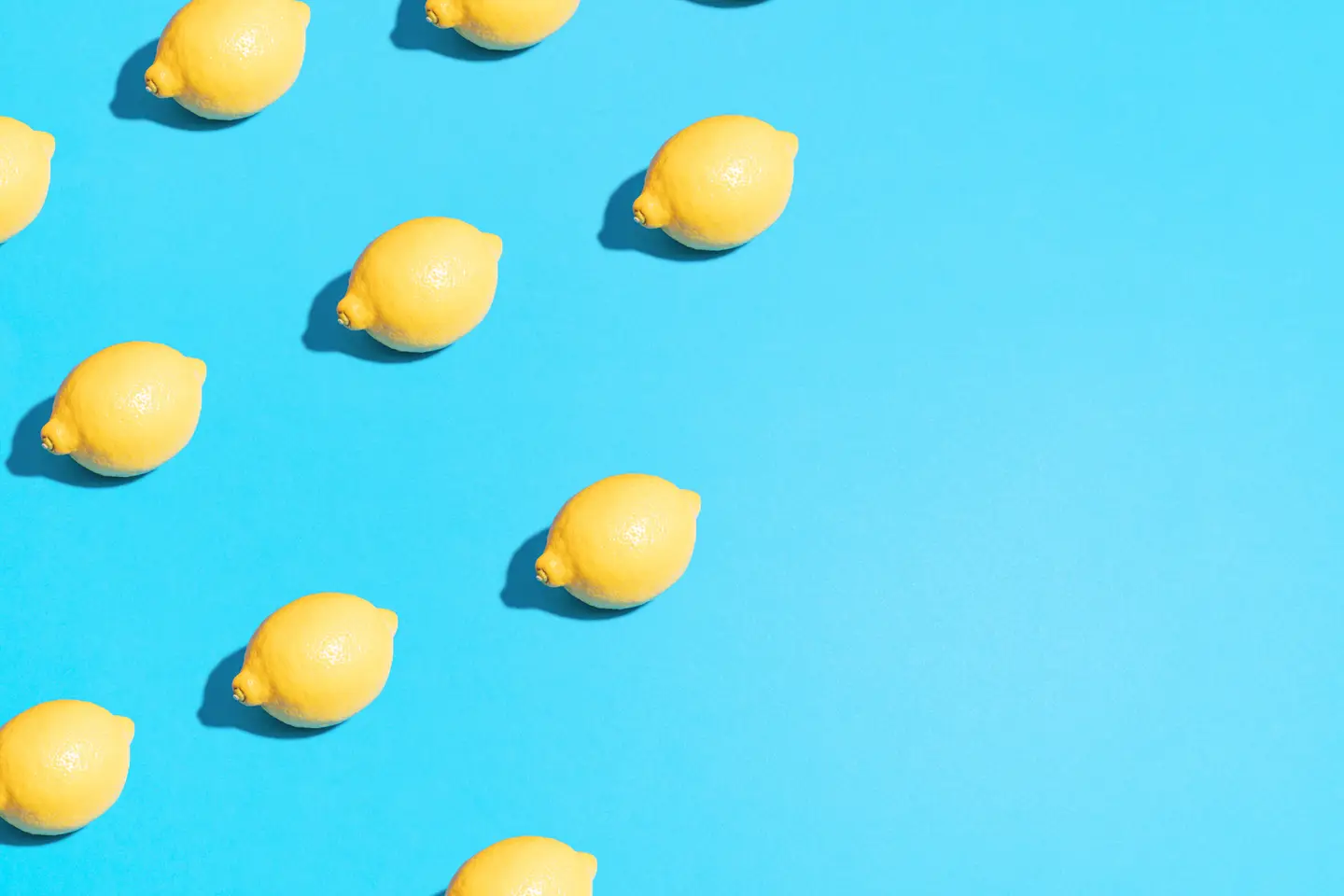
Here’s what one license for this photo would let a small shop do with it:
- A tote bag with the lemons across the front and your shop’s name set in the empty blue space on the right.
- A sticker sheet made from single lemons you cut out with our free background remover. Editing is allowed and doesn’t change the license.
- A mug with the pattern wrapped around it, printed on demand as orders come in.
- Summer packaging: the photo on tissue paper or box inserts for a seasonal range.
- A product listing banner for the same collection, since ads and web use are covered too.
What it wouldn’t let you do: sell “lemon pattern, instant download, high resolution” on a marketplace. Same photo, but now the buyer gets the file, not a product.
For large prints, check the size your print provider asks for before you order. If the photo is too small for a big blanket or poster, our HD Upscaler enlarges it up to 4× (to 4K) for 1 credit.
What about photos with people, logos or landmarks?
This is where most merch problems come from, and the photo’s own flags tell you what you need.
- People. A recognizable face on a T-shirt can look like that person endorses your brand. The license doesn’t allow use “that implies endorsement by a person shown without the proper release.” For merch, use only photos of people that have a model release.
- Editorial-only photos. These are for news and commentary: think events, famous places at a specific moment, visible brand names. They can’t go on products. The limit is shown on the photo.
- Logos and brands in the frame. A photo can be licensed while the logo in it still belongs to someone else. Keep other companies’ logos, characters and packaging off your merch.
- Buildings and private property. Some need a property release for commercial use. Again, the photo’s details say whether it has one.
The easy route for merch is what we did with the lemons: objects, textures, food, nature and patterns, with no people and no brands. They carry none of these limits.
Can you put AI images on merch instead?
Yes. You can use AI images you create with us for commercial use, including on products, and each one costs 1 credit. But two things are different from a stock photo.
First, AI images come with no legal protection, while a stock photo is covered up to $5,000 for claims about the photo itself. Second, an AI image may not be copyrightable in many countries. The US Copyright Office concluded in its 2025 report on AI and copyrightability that prompts alone don’t give enough human control to make you the author of the output. For merch, that means someone could copy a design that is purely AI-made and you may have little to stop them. Your own type, layout and edits on top are what you can protect.
If you sell on a marketplace, check its rules too. Etsy’s Creativity Standards, for example, ask sellers to be clear about who designed an item and whether AI or a production partner was involved.
For a fuller comparison of the two, see stock photo or AI image? How to choose for each job.
A checklist before you send a design to print
- Is it a product, not the photo? The buyer should be getting a shirt, a mug or a box, never the image file.
- Is the photo editorial-only? If yes, it can’t go on merch. Pick another.
- Are there recognizable people? Only with a model release.
- Any logos, brand names, characters or artwork in the frame? Crop them out or choose a different photo.
- Will you stay under 500,000 copies? Count every printed item, including print-on-demand orders.
- Is there something of yours on it? Your type, layout or illustration makes the design yours and harder to copy.
- Is it big enough to print? Check your print provider’s size, and upscale if you need to.
- Do you have a record? Note the photo’s ID and the date you licensed it next to the product, so you can answer any question about it later.
Your next step
Pick one product you already sell or want to sell, then search our stock photo catalog for objects, textures and patterns that fit it. You get 30 free credits when you sign up, no card, which is enough for three photos to try on your mockups. The full terms are on our license page, and pricing shows what more credits cost.
This is general information, not legal advice. For the exact terms, read our license.
Questions people ask
- Do I need a separate license for every T-shirt I sell?
- No. One license for a stock photo covers print runs up to 500,000 copies, worldwide, with no expiry. Count every printed item toward that number, including print-on-demand orders.
- Can I use the same stock photo on several different products?
- Yes. The license covers the photo in your commercial projects, so one photo can appear on a shirt, a mug and your packaging. Keep the total number of printed copies under 500,000.
- Can I sell a stock photo as a digital download on Etsy?
- No. Selling the image file, a wallpaper or a pattern pack gives the buyer the photo itself, which the license doesn't allow. Sell a product that uses the photo instead.
- Can I edit a stock photo before putting it on merch?
- Yes. You can crop it, remove the background, add text or recolor it, and the license stays the same. The legal protection covers the original photo, not the parts you add.